Choosing the right refractory anchor shape is one of the most consequential decisions in lining design — yet it is often reduced to habit or cost. An engineer who always specifies Y-type may be overspending on simple duct linings. A procurement team that defaults to V-type may be under-anchoring a furnace roof. And U-type anchors remain underused on curved vessels where they would dramatically outperform the alternatives.
This guide breaks down the three standard anchor shapes — Y-type, V-type, and U-type — with engineering-level detail on geometry, mechanical behavior, application fit, and cost. By the end, you will know exactly which anchor to specify for each zone of your equipment.
Section 01
Quick Comparison Table
| Parameter | Y-Type | V-Type | U-Type |
|---|---|---|---|
| Shape Geometry | Central stem + two diverging upper arms forming a Y | Two legs forming an open V (steer-horn design) | Rounded U-profile, two parallel or near-parallel legs |
| Holding Strength | ★★★★★ Highest — 3-point interlock | ★★★★ Good — 2-point grip | ★★★★ Good — distributed on curves |
| Pull-Out Resistance | ~25% higher than V-type | Baseline reference | Similar to V, superior on curves |
| Best Application | Heavy-duty: roofs, thick linings, high-vibration, overhead | Standard: sidewalls, ducts, medium-thickness castable | Curved: rotary kilns, cylindrical vessels, dual-layer |
| Lining Thickness | Medium to thick (100–300mm+) | Thin to medium (50–200mm) | Medium to thick, dual-layer |
| Installation | Hand welded (SMAW) or stud-base | Hand welded — fastest, simplest | Hand welded or bolted |
| Relative Cost | $$$ — Higher | $$ — Most economical | $$–$$$ — Moderate |
| Surface Suitability | Flat walls, roofs, floors | Flat walls, inner diameters | Curved outer & inner diameters |
Section 02
Y-Type Anchors — The Heavy-Duty Standard
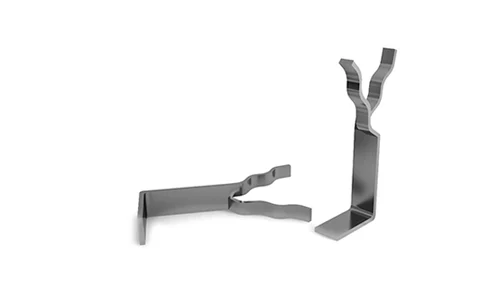
The Y-type anchor has a central stem that splits into two upper arms, creating a three-dimensional grip within the castable. This geometry gives it the highest pull-out resistance of any standard anchor shape — approximately 25% greater than an equivalent V-type of the same material grade and wire diameter.
The central stem acts as a primary tension member, while the two arms distribute load laterally into the castable body. This three-point interlock resists both direct pull-out (tensile) and lateral displacement (shear) forces — making Y-type the preferred choice wherever mechanical demands are highest.
When to specify Y-type:
Furnace roofs and ceilings (gravity loads), sidewalls with vibration or thermal cycling, thick linings over 150mm, high-stress zones near burners, any overhead application where lining fall-out is a safety risk.
✅ ADVANTAGES
Highest pull-out resistance. Superior mechanical interlock in thick castable. Best for overhead/roof. Handles thermal cycling and vibration. Available in split and solid variants.
⚠️ LIMITATIONS
Higher material cost per anchor. More complex fabrication. Not ideal for thin linings under 75mm. On curved outer surfaces, V or U may perform better.
Section 03
V-Type Anchors — The Versatile Workhorse
The V-type anchor is the most widely used refractory anchor shape worldwide. Its simple two-leg open design makes it easy to manufacture, fast to install, and cost-effective in bulk. The V-shape provides reliable holding power for standard castable linings on flat walls and inner diameters.
V-type anchors work best when the lining is moderate thickness and mechanical demands are standard — typical sidewall applications in furnaces, kilns, ducts, and preheater cyclones. They allow thermal expansion within the open V geometry.
When to specify V-type:
Standard furnace sidewalls, ductwork linings, preheater and calciner walls, moderate-temperature applications, budget-sensitive projects, any application where simplicity and speed are priorities.

✅ ADVANTAGES
Most economical. Simplest to manufacture and install. Fastest welding time. Available in all grades. Proven in millions of installations globally.
⚠️ LIMITATIONS
~20-25% less pull-out resistance than Y-type. Not recommended for overhead without tighter spacing. Poor on curved outer surfaces. Less interlock in thick linings.
Section 04
U-Type Anchors — The Curved Surface Specialist
U-type anchors have a rounded profile with two parallel or near-parallel legs connected by a curved base. This distributes stress evenly on curved surfaces — eliminating point-loading that Y and V anchors create on vessel curvature. They are the natural choice for rotary kilns, cylindrical reactors, and curved shells.
U-type anchors also excel in dual-layer lining systems where the anchor passes through an insulating backup and anchors the dense hot-face castable. The parallel-leg design accommodates two layers without stress concentration at the transition.
When to specify U-type:
Rotary kiln castable zones, cylindrical vessels, incinerator shells, dual-layer linings, glass furnace crowns, any application with significant shell curvature.

✅ ADVANTAGES
Superior on curved surfaces. Excellent for dual-layer systems. Even stress distribution. Flexible under differential thermal expansion.
⚠️ LIMITATIONS
Lower pull-out than Y-type on flat surfaces. More expensive than V-type. Less common in standard inventory. Not best for flat single-layer walls.
Section 05
Decision Matrix — Which Anchor for Your Application?
| Application / Zone | Recommended | Why |
|---|---|---|
| Furnace roof / ceiling | Y-Type | Maximum pull-out resistance against gravity |
| Standard furnace sidewall | V-Type | Cost-effective, fast install, adequate strength |
| Rotary kiln (castable zones) | U-Type | Curved surface, shell flexion, thermal cycling |
| Ductwork & flues | V-Type | Light-duty, thin linings, high volume, low cost |
| Preheater cyclone | V / Y Mix | V on walls, Y on target walls & high-abrasion |
| Burner pipe (external curve) | U-Type | V fails on outer curves; U distributes load |
| FCC reactor / reformer | Y-Type | Thick linings, high thermal stress, vibration |
| Boiler membrane wall | Stud-Welded | Thin linings on tube surfaces |
| Dual-layer lining system | U-Type | Parallel legs pass through both layers |
| Steel ladle / tundish | Y-Type | Heavy-duty, thick castable, extreme temps |
💡 PRO TIP
Most vessels benefit from mixing anchor types by zone. Use Y-type in critical high-stress areas and V-type in standard sections to optimize performance and cost. This is standard engineering practice — not a compromise.
Section 06
Anchor Selection by Industry
Cement Plants
Preheater: V-type SS304/SS310. Calciner: Y-type SS310. Rotary kiln transition: Y-type SS310/Inconel. Nose ring: Y-type Inconel 600. Cooler: V-type SS304. Burner pipe: U-type for curved external.
Oil & Gas / Petrochemical
Fired heaters: Y-type SS310 (radiant), V-type SS304 (convection). FCC reactor: Y-type Inconel 600. Reformer: Y-type Inconel. Transfer lines: V-type SS310 standard, Y-type for elbows.
Steel & Iron Plants
Blast furnace stoves: Y-type SS310. EAF sidewalls: V-type SS310. Steel ladles: Y-type Inconel 600. Tundish: V-type SS310. Coke oven doors: Y-type SS310. Reheat furnace roof: Y-type SS310.
Power Generation
CFBC combustion: Y-type SS310. Cyclone targets: Y-type SS310. Windbox: V-type SS304. Burner throats: V-type SS310. Membrane walls: stud-welded pins.
Need Y, V, or U-Type Anchors?
Santura Engineering manufactures all three in SS304, SS310, Inconel 600/625, Incoloy 800H, SS321. Solution-annealed with plastic caps. Factory-direct from India.
Request a Free Quote →Frequently Asked Questions
What is the difference between Y-type and V-type refractory anchors?
When should I use U-type anchors instead of Y or V?
Which refractory anchor type is strongest?
Can I mix different anchor types in the same vessel?
What anchor type is best for cement kilns?
Does Santura manufacture all three anchor types?
Related Guides & Resources
CONTENTS
Quick Comparison TableY-Type — Heavy-DutyV-Type — VersatileU-Type — CurvedDecision MatrixBy IndustryFAQNeed Anchors?
Y, V, U in SS304, SS310, Inconel. Factory-direct from India with mill certs & caps.
Get Quote →